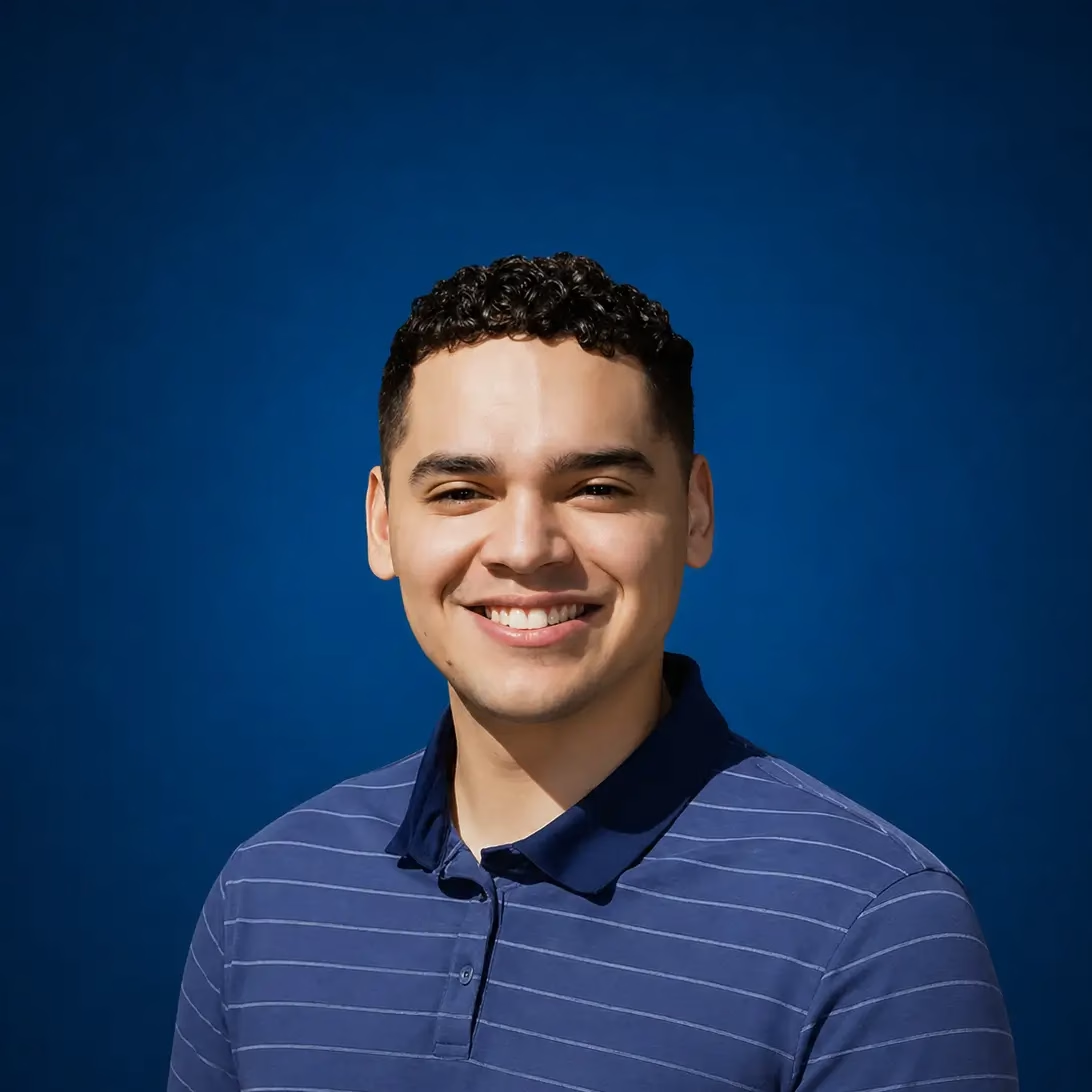
I went to Opal six weeks ago expecting to come back with a few useful ideas. What I did not expect was to sit through sessions and feel like each one was naming something I had been circling around in my own work but hadn’t found the right words for yet.
Opal Group’s People Development Executive Summit brought senior L&D, talent, and leadership-development professionals to Palm Springs from June 14–16, 2026. Speakers included Neil Hunter, Chief Learning Officer at Deloitte Canada; Will Feng, Global Head of Learning & Leadership Development at Fabletics; and leaders from Microsoft, Block, Nuvei, and other organizations. The agenda ranged across AI, Gen Z, culture, people data, and the long game of making development stick.
These are the ideas that stayed with me. If you work in L&D, lead a team, or shape how your organization develops people, I hope they give you a useful question to carry into your next meeting.
|
SESSION
01
|
Neil HunterChief Learning Officer, Deloitte Canada
|
The Only Advantage AI Can’t Commoditize
Neil Hunter opened with a question most people in the room had probably been asking themselves quietly for a while: if AI keeps getting better at doing what we do, what differentiates us?
His answer was not what I expected. He did not talk about creativity or emotional intelligence in the abstract way those topics usually get handled. He went deeper: the human capacity to think adaptively, to learn in context, and to work through genuine ambiguity with other people is the only thing that will matter competitively once every organization has access to the same AI tools.
Access to AI will level out, and when it does, advantage will come from the humans using it — and from how well those humans have been developed.
As access to AI expands, the quality of your people and the depth of their development become more visible differentiators.
For those of us in leadership development, that is clarifying. Human capability is part of business strategy: organizations need people who can frame a problem, question an output, read a room, and act when the playbook runs out.
This maps directly to the work we do at Leadership Edge Live through programs such as Emotional Intelligence and Skillful Collaboration. More than just nice-to-have skills, these are the skills that hold their value precisely because AI cannot replicate them.
|
SESSION
02
|
Will FengGlobal Head, Learning & Leadership Development, Fabletics
|
AI Readiness Starts With People
This was my favorite session.
Will Feng talked about how Fabletics approached AI adoption, and the first thing he said was that they stopped calling it a technology rollout and started treating it as a culture change. “We bought the licenses” is not a culture strategy.
The distinction sounds small, but it isn’t. Organizations that frame AI adoption as a technology problem focus on tools, access, and training people to use specific platforms. Organizations that frame it as a culture problem focus on whether their people are curious, adaptive, and willing to keep learning when the tools keep changing. The second approach builds something that lasts; the first builds a capability that goes obsolete.
Will introduced a “Superlearner” framework for building readiness at three connected levels: individual, team, and organization. Each level asks a practical version of the same question: what helps people stay curious, learn faster, and keep adapting together?
Genuine AI readiness grows in a culture where people want to keep learning, feel safe trying new approaches, and trust one another enough to adjust when an experiment misses.
The idea of a Superlearner — someone who actively accelerates their own learning — felt familiar. The most effective people I have worked with do not wait for the next course to update their thinking; they look for feedback, test assumptions, and keep moving.
That is also why live, facilitator-led learning has a distinct role. Real-time interaction, feedback, and practice create conditions a video library alone rarely provides.
|
PANEL
03
|
Steven Astrein Guidde Ashley Zucchet Logan Nuvei Johnny Stoneburner Block Patrick Carrion MCM Worldwide |
How AI Training Programs Can Make It Past Day 90
The panel named a failure pattern they called “The 90-Day Cliff.”
Here is the pattern: an organization launches an AI-enabled training program. The first few weeks bring energy, participation, and positive feedback. By day 60 or 90, novelty fades, old habits return, and a program that still exists on paper has stopped changing how people work.
The panel traced that fade to design built around launch energy, weak links to real work, and measurement focused on completion or satisfaction instead of behavior and business impact.
The fix is better design from the start, specifically with Day 91 in mind. What will the program ask people to do then? Which real decisions will it support? What observable behavior will tell us the learning transferred?
A program that gets people through the content is not the same as a program that changes how people work. Most organizations are measuring the first thing and calling it the second.
The panelists also highlighted short, subject-matter-expert-led content that appears close to the moment of need. Compact resources can be easier to revisit, practice, and apply than a single long course.
That aligns with a durable finding from learning science: distributing practice over time generally supports longer-term retention better than massed exposure, especially when learners retrieve and apply what they know. The point is to give people repeated chances to use the learning in context.
|
PANEL
04
|
Kirsten Moorefield Cloverleaf Mary Carroll GDT John “Jay” Longowa Forward Air |
You Cannot Develop People You Do Not Understand
The final session I want to highlight focused on a familiar gap: organizations can collect behavioral insights and talent signals faster than managers can turn them into useful action.
Many organizations already have engagement surveys, performance reviews, assessment results, and retention signals. The opportunity is to bring those insights into the daily decisions managers make with and about their people.
The panel identified three conditions for closing the gap:
- 1. Data needs to appear in the flow of work.
- 2. Insights need plain language tied to real decisions.
- 3. Managers need confidence that honest development conversations will be handled with appropriate care, and not as surveillance.
The organizations actually moving the needle on talent development are the ones where managers feel equipped and safe enough to use what they know about their people to have better conversations, not just to fill out forms.
What I’m Carrying Forward
Two themes stayed with me.
First, the organizations winning on people development right now are the ones with the clearest philosophy about what development is for, and the discipline to build programs around that philosophy rather than around what is easiest to deliver.
Second, AI is raising the stakes for both technical fluency AND human capability. Analytical thinking, adaptability, leadership, collaboration, empathy, and active listening continue to matter alongside AI skills. Organizations that develop both are better positioned to turn new tools into useful work.
I left Opal with a clearer sense of why our work at Leadership Edge Live matters, and a sharper set of questions about how to help learning land more deeply and last longer. That is about as good as a conference can do.
If one of these questions is alive in your organization — how to build AI readiness, make learning stick, or help managers lead with better information — I would enjoy comparing notes. Bring me the messy version.
Bring us the challenge you’re navigating
In 30 minutes, Jonathan will learn what you’re working through, explain how the Leadership Edge Live team may be able to help, and follow up with an introduction to the right expert.
Talk with Jonathan ›